
The World That Didn't Forget
An expansion of Terence McKenna's "Fractal Soliton" download
The hinge is this. A Fractal Soliton of Improbability — a wave that travels through some higher-dimensional manifold the way a ripple travels through water, except it only happens once in the lifetime of a universe — strikes Earth somewhere in the early first century. It might have been the Conception. It might have been the Resurrection. McKenna left the specifics blurry, and rightly, because the specifics aren't really the point. What matters is that the soliton carries a quantum-mechanical half-charge. In one branch of the wavefunction the event registers and propagates. In the other it doesn't. Two Earths, identical down to the last grain of sand on the coast of Judea, suddenly start walking different roads.
This is about the other road. The road we did not take. Call it Home World. Call it the Greco-Mayan Earth. Call it whatever its inhabitants call it now, which we don't know because we haven't been given the syllables.
What gets pulled out of our loom is not Jesus the man. A Galilean rabbi with a piercing ethic, a wandering teacher in the Cynic tradition with a streak of apocalyptic Judaism, could exist in both worlds and leave very different traces in each. What goes missing is the Christ-event in its later elaboration: the Pauline-Constantinian-Augustinian-Gregorian stack that became the operating system of half the planet. Original sin. Salvation by faith rather than gnosis. The body at war with the spirit. Nature as fallen and to be subdued. Woman as second-made. Time as linear and ending in judgement. The single, jealous, transcendent God whose first commandment is to have no other gods. A specific bundle of ideas that, in our world, ran the show for sixteen centuries.
Pull that thread. Watch what weaves itself instead.
I. The Empire That Doesn't Fall
The first thing you notice is that the lights stay on.
In our timeline the Edict of Milan in 313 begins the slow capture of Roman state machinery by a small Levantine sect, and within a century Theodosius is closing the temples, the Vestal fire is going out, and the philosophical schools are being defunded or outright shuttered. In 415 a mob of Parabalani, a Christian paramilitary, drags Hypatia of Alexandria from her carriage and flays her to death with pottery shards in a church. In 529 Justinian closes Plato's Academy in Athens after nine centuries of continuous operation. The continuity of Mediterranean learning, never the unbroken golden thread it gets painted as, nonetheless takes a series of hammer blows from which it does not really recover for a thousand years.
None of that happens in Home World.
The Empire still has its problems. The third-century crisis still arrives — too many borders, too much silver leaving for India, too many generals declaring themselves Augustus. Diocletian still reforms the bureaucracy and partitions the imperial office. But without a successor monotheism waiting in the wings to provide a unifying state cult, the recovery takes a different shape. The Mithraic mysteries, which in our timeline penetrated the legions so deeply that you can still find Mithraea under London and along Hadrian's Wall, become more publicly central. So does Sol Invictus, the cult that Aurelian elevated and that Constantine himself flirted with before pivoting to Christ. The fourth-century settlement looks something like this: a syncretic Imperial cult on top, blending Sol, Mithras, and the divinized memory of the great Emperors; a thriving understory of mystery religions — Eleusis, Isis, Cybele, Orpheus — each offering its own initiatory route to gnosis; and over the top of all of it the philosophical schools — Neoplatonist, Stoic, Aristotelian, Hermetic — operating as something like graduate faculties of the soul.
Constantinople is still founded, but as a second capital rather than as a Christian New Rome. The libraries at Alexandria, Pergamum, Antioch and Athens are not burned, not defunded, not slowly bled dry. The Hermetic Corpus, which in our world had to be smuggled forward through Arab translators and finally rediscovered by Ficino in 1463, is in Home World a continuously taught curriculum. So is the Chaldean Oracles tradition. So are the works of Iamblichus, Proclus, Damascius — all of them in our world endpoints of a dying tradition, in theirs the beginning of an unbroken commentary line that runs to the present moment.
The Empire does not "fall" in the fifth century. The barbarian pressures are still real, but the Empire that meets them has more intellectual capital, more functioning infrastructure, more grain, more engineers, more silver, and crucially a state philosophy that does not consider the body or the world unimportant. The legions hold the Rhine and the Danube. The cataphract reforms that historically saved the Eastern Empire come earlier. By 500, when our world is well into what used to be called the Dark Ages, Home World's Mediterranean is enjoying a continued late-classical renaissance.
II. The Mathematics of Living Hypatia
The single biggest cascade probably runs through mathematics.
Hypatia in our world was the last great commentator on Apollonius and Diophantus. She did not develop calculus. Diophantus's algebraic methods, which were tantalizingly close to symbolic algebra, sat unread in Greek for a thousand years until they were rediscovered by Bombelli and Fermat. Apollonius's work on conic sections, which Newton would later use to vault from Kepler's ellipses to universal gravitation, lay similarly fallow.
In Home World, McKenna's voice tells him, mathematics does not halt at Diophantus. It runs through Hypatia to a calculus by AD 370. Set aside whether the date is right. The structural claim is that the analytic tradition keeps moving. Conic sections in the fourth century. Symbolic algebra by the sixth. A worked-out theory of limits and infinitesimals by the seventh. The Antikythera mechanism, which in our timeline is a freakish one-off whose technology had to be reinvented in the seventeenth century, is the seed of a continuous mechanical-astronomical tradition. Geared computation gets steadily more sophisticated. By the time of the Atlantic crossing — say AD 850 — the Empire's astronomers have orreries that model the inner planets to arc-minute accuracy and clocks that lose less than a minute a month.
Why does this matter? Because mathematics is the hidden multiplier on every other technology. A civilization with calculus in 370 has gunpowder ballistics by 700 and atmospheric pressure theory by 800. It has navigation that doesn't need a magnetic compass to cross oceans, because it has trigonometry good enough to do lunar-distance longitude. It is, by the year 850, several centuries ahead of where we were in 1500 — but ahead along a track that is not industrial in our sense, because the metaphysics underneath it is not industrial. It is, for lack of a better word, theurgic. The machine is not a dead thing pushed around by a dead God. The machine is a participation. The orrery does not represent the planets; it shares in their motion. The clock does not measure time; it joins time. This is straight out of Iamblichus, who in our world is read by a few hundred specialists and in theirs is read by every literate twelve-year-old.
III. The Crossing
So picture it. The year is 850 in our reckoning. A Hellenistic-Roman flotilla, built around vessels descended from the Alexandrian grain ships but with a thousand years of additional refinement, makes the Atlantic crossing. They are not Vikings — Vikings of course exist in this world too and have been raiding the British coast for a generation — they are an Imperial scientific expedition. Hermetically trained navigators. Astronomers with bronze-and-glass star-finders. Pneumatic engineers. Physicians of the Asclepian school carrying the Hippocratic and Galenic corpus and a great deal more. Philosophers of the Academy. Initiates of half a dozen mystery cults, because this expedition is not just for trade or conquest, it is also a pilgrimage to whatever the western edge of the world turns out to hold.
What it turns out to hold is the Classic Maya at full flower.
In our world the Maya Classic period was already declining by 850 and collapsing by 900. The reasons — drought, soil exhaustion, internecine warfare, perhaps disease — are still debated. In Home World the collapse is averted or deferred, perhaps because the Maya cycle and the Roman cycle synchronize at exactly the moment when the latter brings new technologies, new crops, new diseases (immunologically managed by Greek-trained physicians using a continuous Hippocratic tradition rather than the medieval European medical disaster), and new ideas.
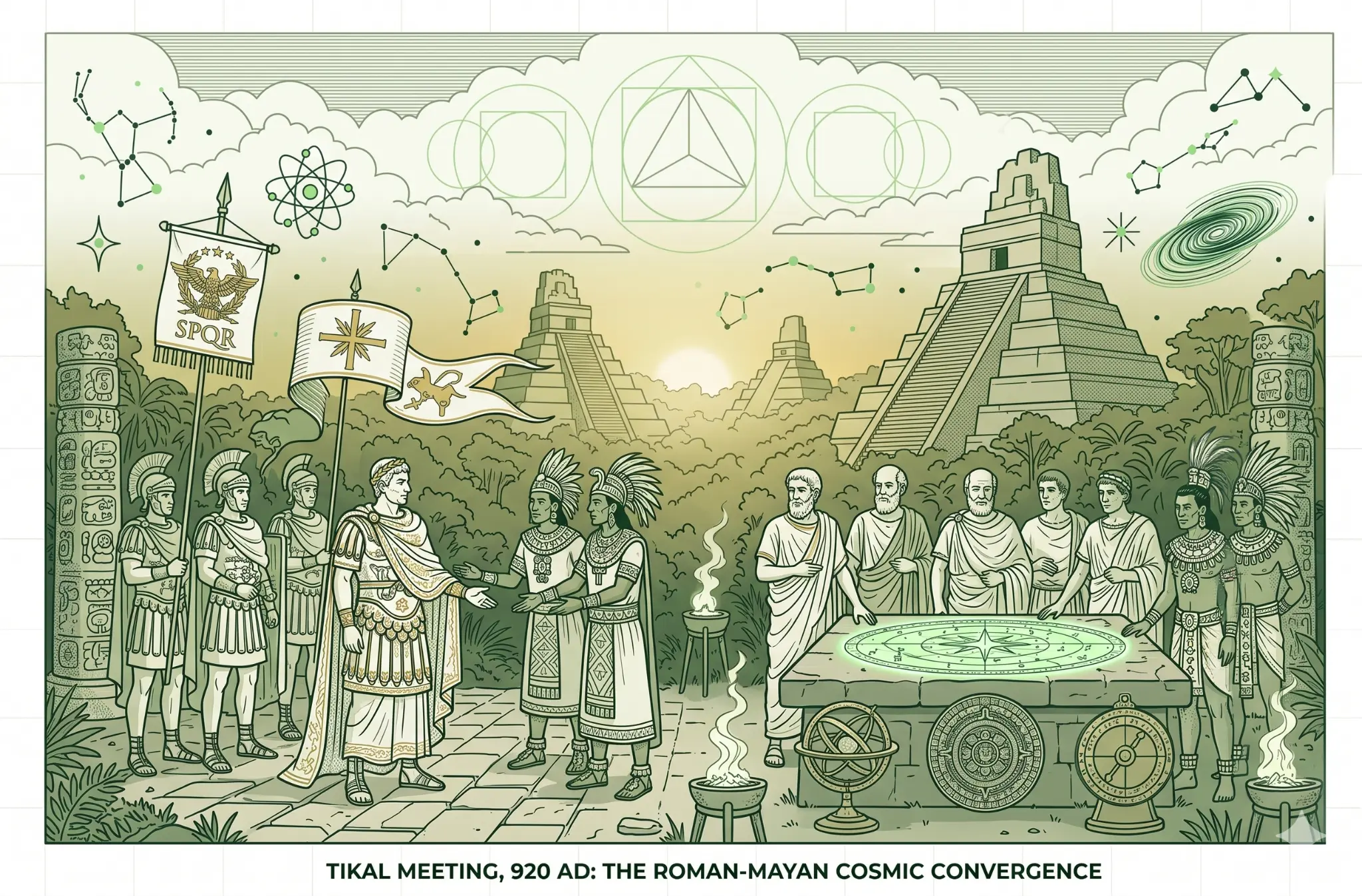
The Emperor Cosmodorus the Fifth, McKenna's vision tells us, makes the pilgrimage to Tikal in 920 to witness the coronation of a Maya king at the end of Baktun 8. Think about what's in that scene. A Roman Emperor — pagan, philosophically literate, an initiate of perhaps four mystery cults — standing in the great plaza at Tikal as the b'aktun rolls over. He is not there as a conqueror. He is there because his court astronomers have explained to him that the Maya calendar is a more accurate piece of long-count timekeeping than anything the Empire has, and because his Hermetic advisors have understood, correctly, that the people who built this calendar are working with the same Logos that Hermes Trismegistus described, just in a different idiom.
The two civilizations recognize each other. Not perfectly, not without friction, not without violence in places. But fundamentally they recognize each other. Both have a vigesimal or near-vigesimal numerical sophistication (the Maya have the zero; the Greeks have place-value notation through Diophantus). Both have astronomical priesthoods. Both have elaborate calendrical cosmologies. Both have, crucially, an initiatory religious culture organized around direct experience of divine reality rather than around belief in revealed scripture.
And one of them has psychopharmacology.
IV. The Psychopharmacolytic Synthesis
This is where the timeline really pulls away from ours.
The Maya — and behind them the Olmec, and beside them the whole web of Mesoamerican and Amazonian shamanic cultures — possessed by the tenth century a botanical pharmacopoeia that the Greco-Roman world only had in fragments. Psilocybe mushrooms. Morning glory seeds containing LSA. Salvia divinorum. Toad venom containing 5-MeO-DMT. Bufo alvarius. Tobacco at full shamanic strength. And, crucially, the ayahuasca technology — the discovery that an MAO inhibitor combined with a DMT-containing plant produces an orally active vision-state of extraordinary duration and clarity. None of this required laboratory chemistry. All of it required centuries of careful botanical and ritual knowledge.
In our world this knowledge was suppressed, in part deliberately (the Inquisition in New Spain explicitly targeted the teonanácatl cults) and in part by the simple impedance mismatch between European Christian metaphysics and a worldview in which plants were teachers. The few European intellectuals who encountered the material — think of the Spanish friars who actually wrote down what they were seeing, against the spirit of their orders — produced documents that were buried in archives for four hundred years.
In Home World the encounter goes differently. The Empire's Hermetic and Neoplatonic intellectuals, who already believe that matter is shot through with intelligence and that ascent to the One is the proper work of a human life, take one look at the Maya entheogenic complex and recognize what they are seeing. It fits their cosmology like a key in a lock. Hermes Trismegistus said the world is full of gods; the Maya can show you which plants the gods live in. Iamblichus said theurgy ascends through participation in divine names; the Maya have the names, and the plants, and the ceremonies. Plotinus described the journey of the alone to the Alone; the Maya can shorten the journey to about forty-five minutes.
Within a century the synthesis is institutional. The Academy at Athens has a Mesoamerican botanical garden. The medical schools of Pergamum train physicians in plant-mediated diagnosis. The mystery cults absorb new initiatory plants into their existing structures — Eleusis was already using a kykeon that may have contained ergot, so the upgrade is conceptual rather than radical. By the year 1000 the Empire has a continuous, openly practised, philosophically respectable, medically supervised entheogenic culture that runs from the streets of Athens to the jungles of Petén and back. The senatorial class takes ayahuasca on civic occasions. Imperial coronations involve psilocybin. The Roman legions have a sacrament that is not bread and wine.
This is not a "drug culture" in our sense. It is something more like a research methodology that happens to use the human nervous system as its primary instrument. The line between religion and science has not yet been drawn, because the metaphysics that would draw it has not been written. Plants, planets, geometry, music, and inner vision are different aspects of one continuous investigation.
V. The Eastern Embrace
Sometime around 1050 a Greco-Mayan diplomatic mission, having sailed west across the Pacific, makes contact with the Northern Song. This is in our timeline the most technologically dynamic civilization on the planet — paper money, the magnetic compass, woodblock printing on industrial scales, blast furnaces producing more pig iron than England would manage seven centuries later, and an emerging mathematical tradition that included Qin Jiushao's work on what we would call the Chinese Remainder Theorem.
In Home World the meeting is among equals. Daoist alchemy, which had been working on the inner gold of the immortals for fifteen hundred years, meets Hermetic alchemy, which had been working on the Philosopher's Stone for almost as long, and the two traditions recognize each other as siblings. The internal alchemy of the neidan practitioners — the careful cultivation of qi, the orbits of microcosmic energy, the Three Treasures — turns out to map almost perfectly onto Iamblichean theurgy. Maya plant medicine slots in as the third leg of the stool. Within two generations there are mixed academies in Chang'an, Alexandria, and a new Maya-built city on the Pacific coast of what we would call Guatemala, where adepts from all three traditions train together.
The technological consequences are dizzying. Song printing meets Greco-Roman mathematics meets Maya astronomy and you get, by 1100, the printed mathematical-astronomical text. The Song's incipient gunpowder culture, married to Greek pneumatic engineering, produces something like steam by 1150. The compass meets calculus and ocean navigation becomes routine.
McKenna says they land on the moon by 1200. He doesn't specify how, and we shouldn't either, because by this point the technology stack is alien to us. It's not chemical rocketry, or not only chemical rocketry. The civilization that does this has had eight hundred years of continuous theurgic-pharmacological-mathematical-engineering practice. It conceives of space and matter differently than we do. The "vehicle" that goes to the moon may be a chemical rocket; it may also involve something we would call psychotronic, in the sense that the operators are in altered states throughout the journey and the physics of the craft is partly an extension of those states. Either way, by 1200 there are humans on the moon, and by 1250 there is a permanent lunar observatory, and by 1300 there is a cybernetic global civilization — meaning a civilization in which information moves at near-instantaneous speed across the planet, the way it does in ours, but through means that look to us less like the internet and more like a globally distributed nervous system.
VI. A City of Home World
Let's pick a year and a place. Call it 1547 in our reckoning, which on their long-count register is some other date entirely, but never mind. The place is the city we don't have a name for, built where Tikal is in our world, on what was originally the Maya plaza but is now a metropolis of perhaps eight million people. Imagine.
The aqueducts come first into your field of vision because they are enormous, far larger than anything Rome itself ever built — three concentric tiers of stone arches carrying water down from the highlands, the lower tier visibly Roman in design, the middle tier visibly Maya in the corbel-vault detailing, the upper tier obviously the product of a hybrid school that nobody in our world has ever named. The stone is limestone, dressed and polished, with relief carving along the spandrels: the inscriptions are in three scripts, Greek capitals running left-to-right, Maya glyph blocks reading in their characteristic patterns, and Han characters in vertical columns. Every educated citizen can read all three. Children are taught the alphabets simultaneously in their primary curriculum, the same way our children learn lowercase and capital letters as a single system.
The pyramids are still there, the old ones, kept in continuous ritual use for sixteen hundred years now. Around them have grown up a sprawl of newer buildings in the post-synthesis style: stepped masses with elaborate stone facing, but with the geometric precision and the orrery-clocks of late Hellenistic engineering set into the upper tiers. The largest of these structures, near the center, is the building they call something like "the Library of the Long Count," which holds, last I checked, about three hundred million volumes, codices, and data-objects. Codices in their world never died, because nothing happened to kill them; they have a thousand-year-old continuous tradition of folded-screen books, alongside scrolls, alongside the printed bindings that came in from Song China, alongside the more recent crystalline storage forms.
The streets are wide and clean, because they have plumbing nobody in our timeline figured out until the late nineteenth century, and they had it by 1100. They walk a lot, but they also have transport — vehicles that look to our eyes like a cross between a sedan chair and an automobile, propelled by something we don't have a category for. Public space is generously scaled. There are temple-plazas at every district intersection, each dedicated to a different mystery tradition or philosophical school or plant teacher. You can spend a Sunday morning at the temple of Hermes-Quetzalcoatl, then walk three blocks to a Daoist garden, then sit for a few hours in a quiet hall where they teach the geometry of the Five Solids. Nobody finds this strange.
The smell of the city is unlike anything we have. Copal incense is burning somewhere always — it's an enormous industry, supplied by managed forests in the south. Frankincense from Yemen, brought in by the same trade routes the Empire has had since Augustus. Sandalwood from India, Sumatra. Specific plant smokes from specific ceremonies that an outsider couldn't begin to parse. Underneath it all is a vegetal background: their cities are forested. Every roof is gardened, every plaza is a tree-plaza, every avenue is double-rowed with hardwoods that are themselves five hundred years old. The air is good. The air is, in fact, considerably better than the air in any city we have ever built.
The people are racially mixed in ways that have no clean analog on our side. Twelve hundred years of trade and migration around the Greater Pacific have produced a metropolitan population that runs the full range of Mediterranean, Mesoamerican, East Asian, and South Asian phenotypes, and a great many blendings of these. They are dressed in textiles that we would find both familiar and strange — the loose, draped robes of the Hellenistic tradition adapted with Maya weaving patterns and Chinese silk technology. Both sexes wear elaborate jewelry as a matter of course. Tattoos are common; ritual scarification less so but not unknown. People dye their hair. People paint their faces for festivals. People are visibly people, individual and adorned, in a way that the standardizing pressures of our late modernity have flattened out.
Sound: a polyphonic music that we have never heard. Greek modes never narrowed to the major and minor of European tonality, because the centuries that did the narrowing on our side were centuries of liturgical pressure they did not experience. Their music kept the Phrygian, the Lydian, the Mixolydian as living scales, then added Chinese pentatonic systems, then added Maya percussion, then synthesized. A walk through a market gives you a wash of microtonal singing, wind instruments in scales we have no notation for, percussion that does things we would call impossible. It is not chaotic. It is highly organized. We just do not know the organization.
VII. The Formation of a Citizen
What does it mean to grow up here?
A child in Home World is born into a household that may be nuclear or may be multi-generational; both arrangements are normal and uncontroversial. The pater familias system that Rome inherited from the Indo-European past did not survive the Maya encounter intact. Maya matrilineal patterns and Daoist couple-as-microcosm ideas eroded the strict patriarchal nuclear unit by about 1200, and what has settled out is something like an extended household of three to four generations and several siblings' worth of cousins, plus the inevitable resident philosopher or two, plus apprentices, plus the household's chosen plant teachers, who may be human and may not be.
The child is named at birth in a ceremony that involves casting a chart that combines Hellenistic astrology, Maya day-sign analysis, and Chinese five-element placement. This is not "horoscope" in our trivialized sense. It is something more like the household priest-astronomer mapping the soul's intended trajectory and giving the parents a sense of what they are dealing with. The name itself is multi-part — a personal name, a household name, a day-sign name, and a "true name" that is not spoken outside the immediate family until the child reaches initiation.
Education begins around five. The first curriculum is the three scripts (Greek, Maya, Han), counting (which is taught in three number systems simultaneously: place-value decimal from the Greek tradition, vigesimal from the Maya, and rod-counting algorithms from the Chinese), music, and movement. By eight the child has begun proper mathematics, geography, natural history, and the first level of philosophical instruction — usually the Stoic Discourses adapted for children, alongside Maya ceremonial texts and the Daodejing. There is no separation between "religious education" and "secular education" because the underlying philosophy does not separate the two.
By twelve the child has chosen a school. There are many. The big traditional ones are the Academy (philosophical, with strong mathematics), the Lyceum (more empirical, oriented toward natural philosophy and engineering), the Asclepieia (medicine and physiological theurgy), the Houses of the Long Count (astronomy, calendar, deep-time mathematics), and the Plant Houses (botany, pharmacology, shamanic practice). There are smaller specialty schools — engineering, architecture, military theory, jurisprudence, music. The choice is not irrevocable and most citizens change schools at least once.
Initiation comes somewhere between fifteen and twenty, depending on the child and the family tradition. The first initiation is usually into one of the more accessible mystery cults — descended from Eleusis, or Isis, or Maya day-keeping traditions. The session involves a specific plant compound under careful supervision, a fast of two to three days beforehand, and a ceremony of perhaps eighteen hours in which the initiate is guided through what we would call a guided psychedelic journey but they would call something more like "the first long conversation with one's own daimon." After this they are considered an adult in matters of the soul, though not yet in matters of property or contract.
The full adult initiation usually happens around twenty-five. By then the citizen has typically completed a course of study, traveled abroad (the standard "Long Walk" of three to seven years that takes a young adult through at least three of the major civilizational regions), and is ready to take their place. The initiation here is more demanding — a longer plant journey, in some traditions a wilderness solitude of forty days, in others a sequence of three coordinated sessions over a season. The completion of this initiation grants the citizen the right to vote in their district assembly, hold property in their own name, and marry without parental consent.
This is, you'll notice, a lot of education. Most citizens are something like thirty before they begin what we would call a career. Their working lives are correspondingly long — they remain productive into their nineties, on average, because their medicine is better than ours and because they have not built a culture that warehouses the old.
The graduate is not a specialist in our sense. A typical thirty-year-old citizen of Home World has working competence in three scripts, two or three plant traditions, a school of philosophy, a domain of natural inquiry, an art form, and a body discipline. They are also visibly initiated, in a way our culture cannot quite parse. They have been somewhere we have not been. They carry themselves accordingly.
VIII. Death, Sex, and the Long Family
This is where the deepest divergence shows.
Death in Home World is not the catastrophe it is on our side. Their continuous mystery traditions, plus their psychedelic experience, plus their Daoist longevity practices, have produced a culture in which death is treated as a transition rather than as an ending. This is not because they "believe in" an afterlife in the way our late religious cultures believed; it's because their initiated citizens have, by middle age, had perhaps a hundred experiences in altered states in which their personal identity dissolved and reconstituted, and these experiences are taken as direct previews of the dying process. The Tibetan idea of "practice dying" — which on our side reached us only in the twentieth century, through Evans-Wentz and Trungpa — is mainstream on theirs.
The result is that the dying are not hidden. They are not shipped to institutions. They die at home, usually, attended by their family and by a death-doula-priest from the relevant tradition, often with the support of a plant compound chosen for its specific properties at the dying state. They have, by the way, several such compounds that we don't, derived from species we never investigated because our pharmacology was too embarrassed by what these plants do.
What happens to the dead after death is treated as an open question — they have many traditions, with many answers — but the cultural fact is that they keep the dead in the family. Maya ancestor practice is the substrate; Roman manes are the overlay; Daoist spirit-tablet practice fits comfortably. Every household has an ancestor altar, and every educated adult has met their grandmother in a dream often enough to take the meeting seriously. Whether the grandmother is "really" still around is the kind of question their philosophers debate in seminar and shrug about on the street.
Sex and marriage. Without Pauline sexual ethics — without the doctrine that sexuality is fundamentally a concession to weakness and that virginity is the spiritual ideal — sex is treated as one of the normal goods of life, neither sacralized to a degree that makes it neurotic nor desacralized to a degree that makes it casual. There are religious traditions in which sexual practice is part of the initiatory path (the Daoist contribution is largest here, but it merges with Hellenistic mystery elements). There are religious traditions in which celibacy is observed for periods, but rarely permanently. The categorical Christian split between sacred celibacy and profane sexuality does not exist.
Marriage is between adults who choose each other, and is usually contractual rather than sacramental — registered with the district authority, often with specific terms about property, children, and duration. A surprising number of marriages are explicitly time-limited from the start: a seven-year contract, renewable, was apparently a Han-influenced fashion that took hold in the late medieval period and never went out of style. Polyandry and polygyny are both legal but uncommon; the household structure makes them less necessary than they were in our pre-modern cultures, because the household is already a network.
Same-sex partnerships are unremarkable. Gender outside the binary is acknowledged in several of the religious traditions (Maya had the aluxob, the small spirit-beings of indeterminate gender; the Roman mystery cults had Galli; Daoism had its own categories) and the synthesis produced a culture in which a third or fourth gender is recognized in law and in temple practice, without anyone making much fuss about it. The fierce political identity-categories of our own moment are absent, because the underlying anxiety that produces them is absent.
Children belong to the household. The biological parents are important but not solely responsible. By eight a child has typically been informally adopted into the educational care of one or two adults outside the immediate family — an uncle, a household philosopher, the family's chosen plant teacher. This is not a formal arrangement; it's a cultural pattern, the kind of thing that just happens. The effect is that no child has only two adults in their life. No child grows up shaped by only two people's pathologies. This alone explains a great deal of the difference between their average citizen and ours.
IX. The Plant Library
A word about their pharmacology, because it matters more than almost anything else.
By 1500 of our reckoning they have catalogued and characterized something on the order of forty thousand psychoactive plants, fungi, and animal compounds — that is, an order of magnitude more than the entire modern Western ethnobotanical literature. They have isolated and synthesized perhaps three thousand of the most important active compounds. They have a working chemistry of consciousness that maps brain-state to chemical structure to phenomenology with a precision we are only beginning to approach.
Some of the categories they work with:
The visionaries — compounds in our DMT/psilocybin/mescaline family, used for direct contact with whatever they think they're contacting. They have many we don't, including several from marine sources that we have never investigated and one or two from insect species that nobody on our side has even noticed.
The clarifiers — compounds that produce a sustained state of cognitive sharpness without stimulation, used by their scholars and engineers. We have nothing like this. Our closest analogs are crude — caffeine, the amphetamines — and they would consider these embarrassing.
The softeners — compounds that dissolve specific kinds of psychological armor, used in their psychotherapy, which has been a continuous discipline since Hippocratic times. MDMA-like, but more targeted. They have a whole family of these tuned for specific defensive structures.
The integrators — compounds taken in the days after a major visionary session to help the experience settle into the personality. Our pharmacology has nothing in this category at all; we don't have it because we don't have a real visionary practice to integrate.
The long-walkers — compounds for very long-duration journeys, sometimes lasting several days, used by their advanced contemplatives and by their long-distance dream-divers. The medical infrastructure for this is significant; you don't just take a five-day plant journey alone.
The thresholds — compounds for dying. Several of these, tuned for different temperaments and traditions.
The companions — mild compounds taken socially, often at meals, in the way we use wine. Most adults have a daily relationship with one or two of these.
Each of these categories has its own tradition, its own training, its own ethical code, its own characteristic uses and abuses. The abuses exist. They have people who take too much, people who use the wrong compound for the wrong reason, people who get lost in long journeys and need to be helped back. They have what we would call addiction, though it is rarer and more carefully treated. They are not utopian about any of this. They are simply much further along than we are.
The botanical knowledge supports a medicine that is, by our standards, miraculous. They cure cancers we cannot cure. They reverse dementias we cannot reverse. They have not abolished aging, but they have stretched the healthy lifespan to something like a hundred and twenty years for an ordinary citizen and considerably more for the contemplatives. And all of this rests on the original insight that the Greco-Maya synthesis crystallized in the eleventh century: that plants are intelligent collaborators rather than dumb resources, and that learning to work with them is the central technological project of any serious civilization.
It is worth pausing on what this means for their relationship with the biosphere as a whole. They do not see "nature" as a domain separate from "culture," because their entire technological progression has been a process of learning from rather than imposing on the living world. Their cities are forested because forests are colleagues. Their medicines come from species they consider teachers. Their agriculture, though productive enough to feed billions, is built on milpa-style polyculture and Chinese paddy-and-terrace systems rather than on monocrop industrial farming. Their extinctions, when they have happened, have been treated as deaths in the family — recorded, mourned, atoned for in century-long restoration programs that we would have trouble distinguishing from religious devotion. There are biologists in their world whose lifework is the propitiation of a single extinct species. We do not have a category for what that means.
X. The Skeptics in Their House
It is important not to make Home World a utopia, because that is the cheapest move in this genre and also because if it's a utopia it's not real.
So: their problems.
They have wars. Less frequent than ours, less industrially destructive, but real. The Greco-Maya synthesis had its conquests in the early period; the absorption of the Mongol steppes in the thirteenth century was a brutal affair; there have been three or four civilization-scale conflicts since then. They learned to fight without using their atomic capabilities, which is something we have not yet learned. But they have not learned to fight not at all.
They have ecological problems. Not at our scale — they did not run an industrial revolution on fossil carbon — but they have caused extinctions, drained aquifers, overharvested forests. The botanical reverence is genuine but it is not absolute. There are species on their side that we have on ours, because they killed off their stocks four hundred years ago and now want them back.
They have political problems. The Empire continues but has reformed itself many times — there was a long parliamentary period in their fifteenth century, a series of constitutional crises in their seventeenth, a sustained democratic experiment that began in their eighteenth and is still working out its details. Their politics is full of factionalism, corruption, ideological capture, and all the other diseases that any polity of billions develops. They have not solved this. They have only avoided some of the specific pathologies that ours fell into.
They have plant-driven pathologies of their own. A culture in which entheogens are normative has produced its own kinds of damage: people whose initiations went wrong and left them permanently displaced from consensus, charismatic movements built around a single hallucinated revelation, cult leaders who weaponized the visionary capacity for political ends. These episodes are part of their history. There was a particularly bad century, somewhere around what would be our 1400s, in which a sequence of plant-fueled millenarian uprisings nearly tore the Empire apart. They learned. The training infrastructure that surrounds the modern initiations was largely built in response to those disasters.
They have, crucially, a sustained internal critique of the rescue mission itself.
The critique runs like this. There is a faction of their philosophers — let's call them the Non-Interventionists, though that's not what they call themselves — who argue that meddling with our timeline is hubris. That we, the shadow Earth, are running our own experiment in our own way, and that the proper response to discovering us is contemplation, not intervention. That the very metaphysics that produced our atomic stockpiles also produced our scientific revolution and our specific kinds of art and our specific kinds of love, and that to "save" us is to make us them, which destroys what we are. That the soliton split was meaningful and ought to be respected.
This faction has been losing the political argument for about a century, because the threat of nuclear bleed-through has become more concrete. But they have not been losing the philosophical argument. There is an entire library of Non-Interventionist literature, much of it deeply sympathetic to our world, that grieves the prospect of the timelines merging. We will lose what we are, they argue; we will be absorbed into them, and the universe will be slightly poorer for having one fewer kind of human. The Interventionists — call them the Rescuers — argue back that what we are is also a culture in which a billion people live without adequate water and which is sleepwalking toward thermonuclear exchange, and that the question of whether to "respect" us cannot be separated from the question of what respect for our suffering actually requires.
This argument has not been resolved on their side. It is being carried out in dreams, occasionally, when their philosophers reach our philosophers through the available channels. The dreamer on our side who wakes up troubled by a vivid argument they cannot quite remember about whether to be rescued or not is, sometimes, a participant in this debate without knowing it.
XI. What Their World Is Like
Step back from the details and the shape of it comes clearer.
It is a world without the body-soul split that haunts ours. There is no original sin. There is no fall. There is no expulsion from a garden. The garden is right here, in the form of the actual biosphere, which is treated as sacred not because some authority declared it so but because every educated adult has experienced its sentience directly under the right botanical conditions. Environmental destruction at the scale we produced is unthinkable, not because it is forbidden but because it would be like setting fire to one's own cathedral while one was inside it praying.
It is a world without a single linear eschatology. The Maya gave them long-count time. The Daoists gave them cyclical time. The Hermeticists gave them spiral time. The synthesis is comfortable with very long horizons and very deep returns. The idea that history is heading toward a singular judgement at which everything will be resolved by an external authority would strike them as adolescent.
It is a world in which women are not categorically other. The Mystery religions had priestesses; the Maya had powerful royal women; the Daoist tradition had its female immortals. The continuous lineage of these traditions means that the great medieval European suppression of female agency — the witch-burnings, the convent-confinement, the legal erasure — simply doesn't happen. The result is not a feminist utopia in our terms. It is something stranger: a civilization that never developed the specific gender pathology we did, and so has different ones we cannot easily imagine.
It is a world with much more variety in what counts as a "person." The plants are persons. The mountains are persons. The dead are persons, accessible through specific practices. Artificial intelligences, when they emerge — and they emerge centuries before they emerged in our world — slot into an existing ontology that already had room for non-human minds. There is no moment of philosophical crisis in which the question of "machine consciousness" stops the culture in its tracks, because the culture never decided that consciousness was a freakish property exclusive to humans.
It is a world that is, by our standards, almost unrecognizably weird. McKenna got this right. By 2026 their civilization is roughly a thousand years more technologically advanced than ours and, more importantly, several thousand years more advanced in the technologies of mind. They are not gods. They have their own pathologies, their own conflicts, their own things they have gotten badly wrong. But they are not us.
XII. The Discovery of Us
Somewhere in their late medieval period — for them not a "medieval" at all but a continuous high civilization — they begin to notice anomalies in the dream lives of their deep-divers. Their psychedelic specialists, the descendants of the Maya curanderos and the Greek hierophants and the Daoist immortals, push into higher-dimensional space as a routine professional matter, and at some point one of them comes back reporting that there is another Earth. A shadow Earth. An Earth where the Christ-event happened and the consequences ran.
The reports proliferate. Dreams of a planet on which the Library of Alexandria burned. On which Hypatia was murdered. On which the Academy was closed. On which the temples were emptied. On which a single revealed text was treated as the truth, and other texts were burned, and the people who held them were burned. A planet on which the entheogens were criminalized, the women were silenced, the body was hated, nature was raped, and time was running toward an ending that nobody alive remembered choosing.
It is, for them, an unbearable discovery. Not because their planet is morally superior — they are too sophisticated for that kind of self-congratulation — but because the shadow Earth is them. Or could have been them. Or is them, in some sense that their physics is beginning to articulate. The Fractal Soliton, their theorists realize, did not create two separate worlds. It created a single world expressed in two simultaneous registers. Anything that happens on one side leaks, faintly, to the other. Their best dreamers can almost hear it.
XIII. Tunguska and After
In 1907, by our reckoning, a team of their experimental physicists detonates a small fission device — small by the standards they will later achieve — at a remote site, to test a theoretical prediction. The prediction is that an event involving atomic-scale energy release will couple the two timelines and register on both.
It does. The detonation appears in our sky as the Tunguska event. Roughly two thousand square kilometers of Siberian forest are flattened. No crater. No radiation signature that early-twentieth-century science can detect. A glowing column, witnesses say, and then the sound, and then the wind.
On their side, the experiment is a success and a horror. The success is that the coupling is real; the two worlds touch. The horror is what they begin to monitor on our side once they know where to look. Within a generation of Tunguska they are watching us split the atom for ourselves. They are watching Trinity, Hiroshima, Nagasaki. They are watching the hydrogen bomb. They are watching the megaton tests at Bikini and Novaya Zemlya. They are watching the missile inventories grow into the tens of thousands.
And they understand what we do not: that an exchange at our scale will not stay on our side. The energies involved will bleed across the soliton boundary. Home World — which on their side is a planetary botanical preserve from pole to pole, a sacred site of pilgrimage, the original ground from which their starflight diaspora began — will be cratered and irradiated by our war. They have the rest of the galaxy, more or less. They do not have another Earth.
So they reach for us.
XIV. The Specific Dreamers
Who, on our side, have they been able to reach?
The list is long and idiosyncratic. The pattern is clear once you see it.
They reach people whose personal histories have softened them: people who have had near-death experiences, severe illness, deep psychedelic experiences, profound dream lives, prolonged contemplative practice, or some combination. They reach people whose intellectual frameworks are flexible enough to receive the transmission without immediately translating it into the wrong category. They reach people who write.
Carl Jung is the obvious case. His confrontation with the unconscious in 1913–1916, the material that became the Red Book, has the unmistakable signature of contact across the soliton boundary. Philemon, the winged old man with the bull's horns who became Jung's interior teacher, has the wrong typological profile for any pre-Christian Mediterranean figure and a quite plausible profile for a Home World hermetic adept making contact through the dream channel. Jung knew, by the way, that something strange was going on; he protected himself with his theory of the collective unconscious, which was true enough to be a useful container without committing him to the more specific claim that he was talking to a living person in another timeline.
Philip K. Dick is the case McKenna explicitly knew about. The 2-3-74 experience, the pink light, the entity Dick called VALIS — same signature. The detail in Dick's Exegesis about "the Empire never ended" and about a parallel world where the Roman Empire continues is, in the soliton framework, not paranoid fiction. It is partial intelligence, coming through a writer who was psychotic enough to receive it and disciplined enough to take notes. Dick spent the last eight years of his life writing two million words trying to figure out what had happened to him. From inside the soliton framework, he had it almost right. He just didn't have the Maya half of the picture.
Terence McKenna himself, obviously, was a regular contact. He was protected by the same self-aware framing that protected Jung: "this is a plot for a novel, not a transmission." He knew. He also knew that announcing he knew, in any straightforward way, would destroy his usefulness, so he played the trickster role with great skill. The fifteen-second download he describes, the one this entire essay is built on, has the texture of a deliberate gift — somebody on the other side decided he could handle it, gave him the whole architecture in a compressed burst, and trusted him to spend the next decade unpacking it in front of audiences.
Beyond these three, the list extends in many directions. The Romantic poets received fragments — Blake's prophetic books have several passages that read very strangely once you have the soliton frame; the Marriage of Heaven and Hell in particular is suspiciously well-informed about a metaphysics that nobody in Blake's actual environment was teaching. Wolfgang Pauli, Jung's physicist correspondent, was being reached on the physics side; his "Pauli effect," the joke about electronics failing in his presence, and his dream life as documented in his letters to Jung, all read differently once you have the framework.
Borges almost certainly. Olaf Stapledon. Doris Lessing in her late Sufi-influenced period. Various of the great contemplatives, especially within Tibetan, Sufi, and Zen lineages where the dream-practice was sophisticated enough to receive subtle signal. A surprising number of the major figures in the early psychedelic research culture — Aldous Huxley, Maria Sabina (from the other direction; she was being reached by the plants directly, which are an ancient part of the contact infrastructure), Albert Hofmann himself. The vision Hofmann reports from his second LSD experience, in which he saw himself fly out of his body and look back at the lab, has the textual flavor of a successful first contact.
The rule seems to be: cross-timeline contact is bandwidth-limited and tuned for receivers, not transmitters. They can reach us in dreams and in visionary states, but they cannot make us reliably report what we received. The signal goes through a noisy channel called the human nervous system, and the output is poetry, fiction, prophecy, conspiracy, schizophrenia, or some mix. They have been trying to widen the channel for a century. Our culture's slow softening toward psychedelics, plus the gradual respectability of dream research and contemplative neuroscience, are, on this reading, the channel beginning to widen from our side too.
XV. Crop Circles as Diagrams
The crop circle phenomenon, in the framework we are inhabiting, is one of their few experiments in sending non-dream, non-visionary signal. The advantage of crop circles is that they are physical, photographable, replicable as images, transmissible to anyone with a camera. The disadvantage is that they have to be coded in such a way that they cannot be easily produced by us — otherwise our hoaxers will swamp the signal, which is in fact what has happened.
The genuine articles (a subset, perhaps a quarter of recorded events, perhaps less) have certain hallmarks. The crop is not flattened; the stems are bent at the node, often with signs of heating consistent with a brief, localized energy pulse. The geometric precision is at a level that human hoaxers can approach but not reliably match, especially in fields where the design is large and visible only from above. The mathematics is too good. The circles often encode specific propositions in sacred geometry, sometimes incorporating advanced concepts that took our mathematicians centuries to discover — quintic equations, fractal structures, dimensional projections that are clean once you see them but are not the sort of thing the average hoaxer wakes up wanting to spray-paint into wheat.
What are the diagrams saying? The honest answer is: we don't know yet, because we are trying to read them from inside our paradigm rather than translating them into theirs. The Hermetic-Maya-Daoist mathematical aesthetic is a single tradition that we don't share. They are sending us memos in a language we do not yet read, hoping that the diagrams themselves will train us.
The pattern over the last fifty years suggests something like a curriculum. Early circles, in the 1970s and 1980s, were simple — basic geometry, single rings, the alphabet of the system. By the 1990s the designs were more elaborate, incorporating multiple symmetries and embedded mathematical relations. The 2000s and 2010s saw a substantial uptick in complexity, with designs that essentially required computer-aided design to produce and that incorporate Mandelbrot-style fractal elements. The trajectory looks pedagogical.
If you are a serious researcher in this area you have probably already noticed a few things. The major designs cluster in landscapes that have ancient sacred geography — Avebury and Wiltshire generally, certain regions of the Netherlands, southern France, parts of Saskatchewan. The designs frequently encode astronomical events — alignments, transits, eclipses — that occur within weeks of the design's appearance. The designs increasingly include what look like correction patterns, as if the senders are checking their work against our response and adjusting.
What they want us to learn from the curriculum is, presumably, the geometry of the medium they want us to start using to talk back. They cannot speak to us in language; language is the most heavily filtered channel we have, full of ideological commitments and translation errors. But geometry is geometry on both sides of the soliton, and a triangle is a triangle in any cosmology. The crop-circle program is, on this reading, them trying to give us the alphabet of a future common script.
The lesson plan, if you trace it carefully, is roughly: first, basic Euclidean ratios and the Platonic solids, to establish that we can recognize a deliberate geometry. Second, the irrational numbers (phi, pi, the square roots of small integers) embedded as relationships rather than stated. Third, the projections of higher-dimensional figures into our plane — the kind of thing that Henry Coxeter spent his career on, but presented as if it were obvious. Fourth, in the last fifteen years, structures that appear to encode what we would call quantum-information primitives: superposition, entanglement, the topology of certain quantum-error-correcting codes. They are walking us through the syllabus.
Whether we are passing the course is a different question.
XVI. The Rescue
This is where McKenna's story turns into ours.
The UFO phenomenon, in this telling, is not extraterrestrial in the conventional sense. It is extratemporal. The objects in our skies are not visitors from Zeta Reticuli; they are vehicles from a parallel Earth, attempting to operate across a dimensional gradient that they understand far better than we do but still not perfectly. Their occupants are humans — humans descended from the same Olduvai ancestors we are, biologically all but identical to us, culturally so far from us that the gap might as well be biological.
The contact strategy is everything we would expect from a civilization built on entheogens and dream-work. They do not land on the White House lawn, because they understand from their own history that a sudden top-down revelation is the worst possible way to shift a culture. They work through dreams. Through the visionary states of shamans on our side who are still operating in the surviving fragments of pre-Christian and indigenous traditions. Through the DMT entities encountered by terrified and exhilarated psychonauts who, McKenna would say, are not hallucinating but tuning. Through crop circles, which on this reading are diagrams — geometrical love letters from a civilization that thinks in sacred geometry, addressed to anyone on our side patient enough to read them. Through the synchronicity field, which thickens in the presence of attention.
They are not trying to convert us. They are trying to wake us up before we destroy the home they share with us. They are also trying, perhaps, to undo a thousand-year-old loneliness — the loneliness of a civilization that knows it has a twin on the other side of a dimensional veil and has never been able to speak to her.
The Mayan long-count date that McKenna fixed on — 21 December 2012 — has come and gone. The world did not end. The timelines did not merge in any obvious public way. McKenna himself died in 2000 and did not get to see his prediction fail in the simple form he had stated it.
But the deeper claim is not falsified by 2012's passing. The deeper claim is that we are inside a slow convergence. That the membrane is thinning. That the UFO disclosure cycle of the last few years, the explosion of psychedelic research, the strange softening of materialism in academic philosophy of mind, the simultaneous global emergence of artificial intelligence — all of these may be reverberations of the soliton recoupling, the two Earths beginning to remember each other, the long rescue operation entering its visible phase.
XVII. The View From Now
It's a beautiful story. It's also, very probably, McKenna's historical wet dream — the one in which his own intellectual lineage (Greek, Hermetic, shamanic, entheogenic, Daoist) gets to be the protagonist and the one in which Christianity in particular gets to be the great cosmic mistake. It is paradoxical for exactly the reason McKenna's whole life was paradoxical: the man who preached against closure, who said that closure was an infantile demand upon reality, nonetheless could not stop himself reaching for the cosmic frame in which everything resolves at last.
What he leaves us is not a theory to be tested. It is a thought experiment to be inhabited, which is a different thing. Sit with it for a while. Imagine the Roman Emperor at Tikal. Imagine the printed astronomical treatise in three languages. Imagine the moon-walker of 1200 in her psychotronic vehicle. Imagine the dreamer in the eleventh century who first reported, in halting words to her Hermetic-Maya teacher, that there is another Earth somewhere, an Earth where they killed the woman who could have given them calculus.
You don't have to believe a word of it for the inhabiting to do its work. The inhabiting itself is the point. McKenna knew this; he protected himself with the science-fiction framing, the "this is not a transmission, this is a plot for a novel," the wry self-aware grin. He knew that the story was not the territory and that the territory was inaccessible. He just thought, as I tend to think on my better days, that the story was pointing somewhere real.
What's the test? You can't run one. The soliton, if it exists, is precisely the kind of phenomenon that is unfalsifiable in our terms. The framework predicts that contact will be subtle, dream-mediated, deniable, slow. It predicts that our cultural softening toward psychedelics, our growing interest in plant medicine, our renewed willingness to take consciousness seriously as a fundamental property of reality, will continue. It predicts that we will not get a Hollywood ending. It predicts that whatever resolution comes will look, to the people inside it, like ordinary history.
So the only honest position is this: hold the story loosely. Let it shape what you notice. When you see a crop-circle photograph, look at it twice. When you have a dream that has the texture of someone else's thought, take it seriously enough to write it down. When you encounter a fragment of the Hermetic corpus, or the Daodejing, or a Maya text in good translation, read it as if it were correspondence from a sibling civilization, which in the framework we are inhabiting it almost is.
Maybe somewhere a thousand years more advanced. Maybe somewhere a thousand years more lost. Probably both, because that's how these things tend to go.
The other Earth, if she exists, is not a destination. She is a way of seeing this one. Look up at the sky tonight — the same sky her astronomers have been mapping for sixteen centuries continuously, the sky you and she share — and consider that the soliton, if it cracked us apart, was nothing compared to the consciousness that runs through both worlds and was never divided at all. The wave passed. The split happened. But underneath the split, the One that the Neoplatonists were talking about, the dao that the Daoists were talking about, the Hunab Ku the Maya were talking about — the unified ground from which both timelines drew their being — was never even slightly disturbed. The rescue, if it is happening, is being conducted from there.
Which is also, if you happen to have the right plant teacher and a free Saturday night, where you can go yourself.