
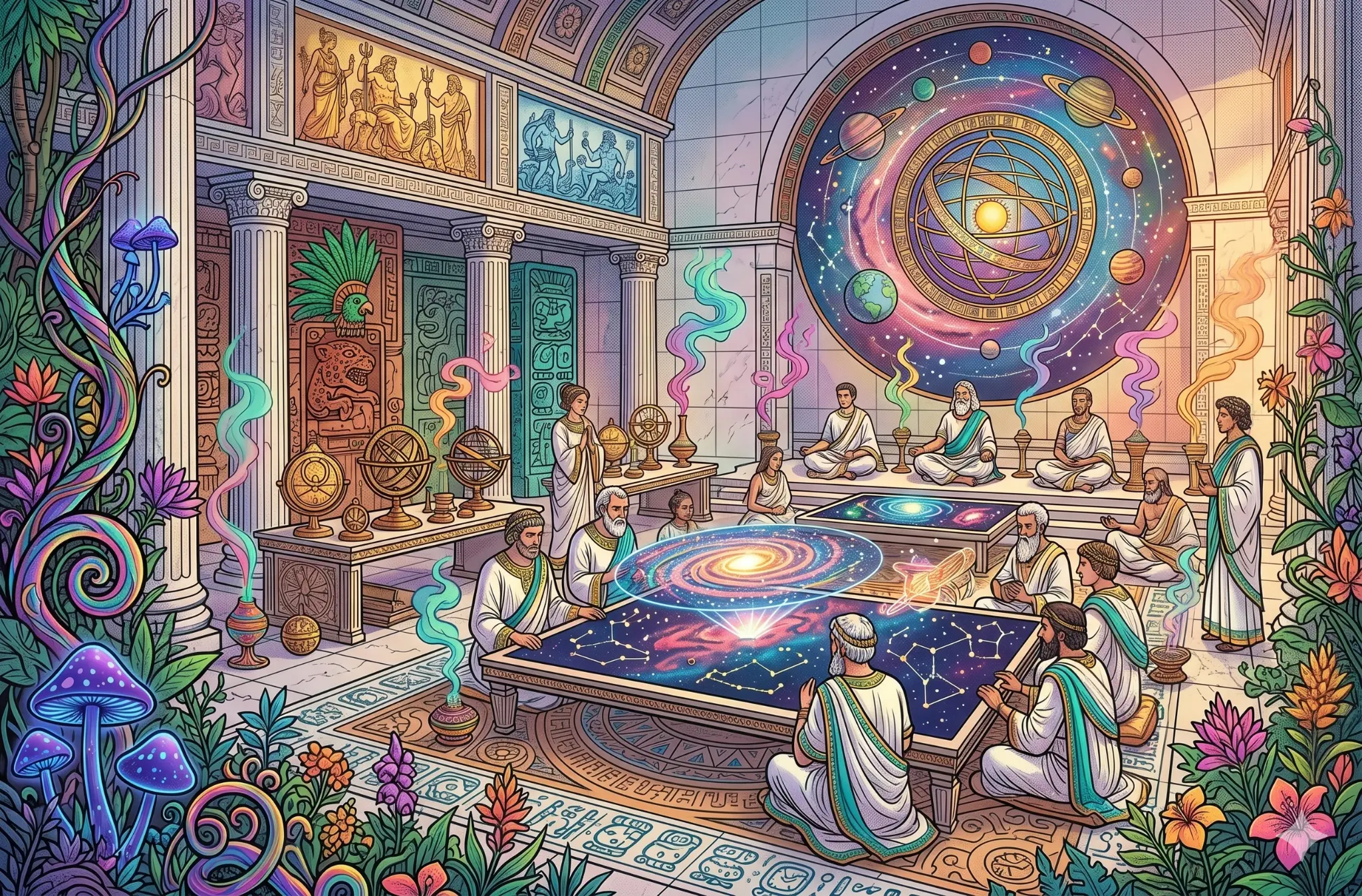
The Unburned (Part 2)
A Roll Call from the Other Earth — companion to "The World That Didn't Forget"
The framework we have been inhabiting requires a thought experiment about specific people. The Christian-Demiurgic timeline did not just suppress an ideology in the abstract; it suppressed particular bodies, particular libraries, particular lineages of practice. If you want to feel the cost, the right exercise is to name the dead.
So here is a roll call. Each entry is a person who in our timeline was burned, condemned, silenced, driven mad, imprisoned, or simply written out of the record — and what they might have done, what their lineage would have produced, in Home World.
This is not exhaustive. It could not be. The witch trials alone killed something like sixty thousand people in Europe between 1450 and 1750, the vast majority women, the vast majority carrying herbal and healing knowledge that died with them. The Cathar genocide eliminated an entire regional civilization in Languedoc. The conquest of the Americas erased uncounted indigenous savants whose names we will never know. The Library of Alexandria is the easy example of the lost archive, but every one of these people was a library too.
The figures named here are the ones whose memory we still have, even partially. Behind each of them stands a crowd we cannot count.
I. The Mathematicians of Alexandria
Hypatia (c. 350–415) is the obvious place to start. Daughter of the mathematician Theon, who edited Euclid's Elements in the form we still use. Last director of the Neoplatonist school in Alexandria. Wrote commentaries on Apollonius's Conics, Diophantus's Arithmetica, and Ptolemy's Almagest — three of the foundational works of late antique mathematics. Designed and built astronomical instruments, including improvements to the astrolabe and a hydroscope for measuring fluid density. Taught a circle of devoted students, including the future bishop Synesius of Cyrene, who left us touching letters describing her as his teacher and friend.
In March 415, during a power struggle between the Christian Patriarch Cyril and the prefect Orestes (whom Hypatia advised), a mob of Parabalani — a paramilitary order of Christian monks — pulled her from her carriage in the streets of Alexandria, dragged her to the Caesareum (a former temple, by then converted to a church), stripped her naked, and flayed her to death with ostraka, sharpened roof tiles or oyster shells. They tore her body apart and burned the pieces. Cyril was eventually made a saint.
In Home World Hypatia lives to be eighty. She extends her father's edition of Euclid into a complete treatment of conic sections, then pushes through into a worked theory of limits — the calculus that McKenna places at AD 370 is in fact her late life's work, finalized somewhere around 420. She trains forty students directly and many hundreds indirectly. The astronomical instruments she designs become standard equipment across the Empire's observatories. Her school survives her by a millennium and a half. Every educated person in Home World can recite the names of her seven principal students and the trajectories of their work the way our educated people can recite the names of the Beatles. The hydroscope, by the way, opens an entire field of inquiry into fluids and pressure that on our side waited for Torricelli in 1644. By 500 her successors have steam. By 600 they have what we would call pneumatic engineering. The line that runs from Alexandria through the centuries is the central spine of the eventual technological civilization.
Theon of Alexandria, her father, lives and dies peacefully and is remembered as the founder of an editorial tradition that keeps the Greek mathematical corpus continuously alive. He never has to bury his daughter.
Synesius of Cyrene (c. 373–414), Hypatia's student and friend, in our timeline became a reluctant Christian bishop and died young, exhausted by the contradictions of serving a church whose intellectual climate was killing what he loved. In Home World he stays a philosopher, writes the great late-Neoplatonist treatise on the relationship between language and being, and dies at seventy after a long career.
Damascius (c. 458–538), the last director of the Athenian Academy in our timeline, who closed the doors when Justinian shuttered the school in 529 and fled to Persia with six colleagues — in Home World he becomes the eighth director of an Academy that does not close, and his great work, Problems and Solutions Concerning First Principles, is in their world the standard graduate text on apophatic metaphysics, read by every educated adult.
Simplicius of Cilicia, who in our timeline fled with Damascius and wrote the commentaries on Aristotle that became almost the only source for pre-Socratic philosophy — in Home World he never has to flee, and the commentaries he writes are vastly more numerous and more confident, because the texts he is commenting on are not endangered species.
The Emperor Julian (the Apostate) (331–363), the last pagan Emperor, who reigned for two years and tried to restore the temples and the philosophical schools, and who was killed in Persia at age thirty-two under circumstances that have always smelled like an inside job — in Home World there is no Christian establishment to defect from, but the Julian-equivalent emperor who consolidates the late fourth-century settlement reigns for thirty-five years, sponsors the schools, and is remembered as one of the great patrons of philosophy in their long history.
II. The Burned Mystics and the High Medieval Heretics
John Scotus Eriugena (c. 815–877), the Irish Neoplatonist at the court of Charles the Bald, wrote the Periphyseon, an enormous work of speculative theology that proposed God and creation are different aspects of a single divine process — almost pure Plotinus laundered through Christian terminology. His work was condemned in 1210 and again in 1225. The Pope at one point ordered all copies burned.
In Home World, Eriugena's intellectual descendants are not condemned but celebrated. The Hibernian school becomes one of the great centers of Neoplatonic mathematics and metaphysics, and the Irish synthesis of Greek philosophy with native Celtic mystery traditions produces a regional flavor of Home World civilization — a strong tradition of geomancy, sacred topography, music, and what we would call ecological theology — that is recognized as one of the four or five distinctive provincial cultures of the global civilization.
Marguerite Porete (c. 1250–1310), French mystic, wrote The Mirror of Simple Souls, a Beguine text that argued the soul could pass through seven stages into a direct unmediated union with the divine, bypassing the institutional Church entirely. She was burned in Paris on June 1, 1310, by order of the Inquisitor of France. She is reported to have remained calm and silent during her trial and her execution, refusing to retract.
In Home World, Marguerite Porete is a celebrated lay teacher whose Mirror is read alongside the Daodejing as one of the two great manuals of the soul's progressive simplification. The Beguine movement — the lay women's spiritual communities that flourished in the Low Countries in the thirteenth century — does not get suppressed. The Beguinages become a major institutional form of Home World religious life: voluntary lay communities of working women devoted to contemplation, mutual aid, and intellectual work. There are perhaps fifty thousand Beguinages in Home World by 1500, holding a substantial fraction of the agricultural and craft economy of the northern Empire.
Meister Eckhart (c. 1260–1328), Dominican preacher and theologian, taught in his German sermons that there is a spark in the soul that is uncreated and uncreatable, that the soul must let go of God in order to find God, that true poverty consists in wanting nothing, knowing nothing, and having nothing. Twenty-eight of his propositions were condemned posthumously by Pope John XXII in the bull In Agro Dominico (1329). His name was effectively erased from the Dominican order for six centuries.
In Home World Eckhart lives to seventy-five and writes a great deal more. His sermons are taught in primary school alongside the Stoic Discourses and the Maya creation stories. The German philosophical tradition that, in our world, had to wait for Kant and Hegel to recover the level of speculative ambition Eckhart routinely operated at — in Home World that tradition runs continuously from him, and by 1600 it has produced the speculative metaphysics that our world only began to articulate in the twentieth century. The convergence of Eckhart's Gelassenheit (releasement) with Daoist wuwei (non-action) and Buddhist sunyata (emptiness) is the seed of a global contemplative philosophy that has no rival on our side.
Cecco d'Ascoli (1269–1327), Bolognese astronomer and natural philosopher, taught at the University of Bologna and then Florence. Wrote L'Acerba, a didactic poem in Italian — one of the earliest works of vernacular science. He was condemned for casting the horoscope of Jesus and arguing that Christ's life had been astrologically determined. Burned in Florence in September 1327, the only university professor burned during the medieval Inquisition.
In Home World, Cecco is a respected professor whose horoscopes are unremarkable because the entire culture practices astrology as a normal branch of natural philosophy. The vernacular scientific poem becomes a major genre in Home World — perhaps three thousand significant works in this form by 1500, in dozens of languages, used to popularize complex material across class boundaries. He dies at seventy-two of a stroke after a heavy dinner, his last words a complaint about the wine.
Joachim of Fiore (c. 1135–1202), the Calabrian abbot whose theology of the Three Ages — Father, Son, and Holy Spirit, the third being an imminent age of mystical participation — was condemned by the Lateran Council of 1215 and again at Arles in 1263. Joachim's actual influence on European thought was vast even in suppression; the secular philosophy of historical progress, from Hegel to Marx, is downstream of him.
In Home World, Joachim's vision of historical phases becomes the formal philosophy of history taught in their schools. The notion that civilization passes through cycles of increasing interiority — first the rule of law, then the rule of relationship, then the rule of direct realization — is in their world a mainstream framework rather than a heresy. Their own civilizational self-understanding is largely Joachimite.
III. The Erased Movements
It is not just individuals who were squashed. Entire communities, entire intellectual ecosystems, were destroyed.
The Cathars of Languedoc, the Christian dualists who believed in a good God of spirit and an evil God of matter (a position any serious Neoplatonist would recognize as a respectable variant of late antique gnosis), were wiped out in the Albigensian Crusade of 1209–1229. At Béziers in 1209 the papal legate Arnaud Amalric, asked how to distinguish Cathars from Catholics in the besieged town, allegedly said: Caedite eos. Novit enim Dominus qui sunt eius. Kill them all. God will know his own. Twenty thousand people in a single day. The last Cathar Perfecti — the ones who had taken the consolamentum, the dualist sacrament that committed them to a celibate, vegetarian, non-violent life — were burned at Montségur in March 1244.
The Cathars had a real theology, a real liturgy, a real ethic. They had women among their Perfecti as equals. They had a doctrine of reincarnation. They had a profoundly anti-materialist metaphysics that nonetheless treated other living beings with reverence.
In Home World, the Languedoc-equivalent tradition is one of the major southern European philosophical schools, with its own dualist metaphysics in dialogue with Neoplatonic monism and Daoist non-dualism. The argument between the dualists and the monists is one of the great ongoing seminars of their civilization. The southern French regional culture is recognized as the home of a particular kind of austere, vegetarian, music-rich contemplative life. The troubadour tradition continues unbroken from the twelfth century into the present, having produced about eight hundred years of additional development of which our courtly lyric is the merest seed.
The Beguines — lay communities of women in the Low Countries from the twelfth century onward, neither nuns nor wives, working as weavers, teachers, healers, and contemplatives — were suppressed at the Council of Vienne (1311–1312) and again repeatedly through the fourteenth and fifteenth centuries. Their books were burned. Marguerite Porete was one of them.
In Home World, the Beguines become a global institutional form. The Pacific coast cities have Beguinages by 1300 that mix northern European, Chinese, and Maya women's spiritual traditions; the Andean highlands have an equivalent that draws on Inca women's weaving guilds; the Mediterranean has descendants of the Roman college of Vestals fused with northern European Beguine practice. They are one of the four or five major institutional forms of Home World religious life, alongside the philosophical schools, the mystery temples, the plant-medicine lodges, and the monastic orders.
The Bogomils of Bulgaria and the Balkans, another dualist tradition, ancestors of the Cathars, persecuted from the tenth century onward — in Home World become the founders of an enormous Slavic-speaking philosophical tradition whose Cyrillic literary culture rivals the Greek. The Russian-speaking philosophical synthesis in Home World, which has been developing continuously from Bogomil seeds for over a thousand years, is one of the deepest contemplative traditions on the planet by 2026.
The Witches. Between 1450 and 1750, perhaps sixty thousand people in Europe — about 80% women — were executed for witchcraft. Many of them were practicing what we would now call ethnobotany. They knew which plants to use for what condition. They were midwives, healers, abortifacient specialists, herbalists. They were the village pharmacologists of pre-modern Europe.
In Home World, these women are the European arm of the global pharmacological project. The Plant Houses of Athens and Tikal have northern European chapters in every village, run by hereditary lineages of herb-women whose knowledge has been continuously refined and transmitted for fifteen centuries. They are not "witches"; they are the local specialists of a continental medical infrastructure. They know which European plants do what — and there are dozens of European plants with significant psychoactive or therapeutic properties that our pharmacology has either ignored or only recently rediscovered, because the lineage that knew them was murdered in waves between 1450 and 1750.
The continental herbal of Home World, the great compendium of European plant medicine assembled in continuous tradition by these women and printed in standard form in the seventeenth century, runs to forty volumes. Ours runs to one, perhaps two, written by male physicians who learned what they learned from women who were burned.
IV. The Renaissance Magi
The Italian Renaissance happened in our timeline because a fragment of the suppressed knowledge briefly broke through. Hermes Trismegistus's Corpus Hermeticum was brought to Florence in 1462 by a Greek monk; Cosimo de' Medici interrupted Marsilio Ficino's translation of Plato to have him translate the Hermetica first, because Cosimo, who was dying, wanted to read it before he died. From that moment for about a hundred and fifty years — until the Counter-Reformation got organized and crushed it — there was a window in which Europeans imagined that the Hermetic-Platonic-Kabbalistic-alchemical synthesis might be made publicly respectable.
The window closed. Most of the figures we associate with it died young, died poor, died in prison, or were burned.
Marsilio Ficino (1433–1499) himself survived. He was lucky — protected by the Medici, philosophical enough to keep his head down when needed. His translations of Plato, Plotinus, Iamblichus, Proclus, the Corpus Hermeticum, and the Chaldean Oracles are the single greatest scholarly achievement of the Renaissance and the foundation of essentially everything interesting that happened in European thought for the next century. In Home World Ficino is not lucky and protected — he is normal. The texts he translates were never lost. His work is one strand among thousands.
Giovanni Pico della Mirandola (1463–1494) wrote the Oration on the Dignity of Man and the Nine Hundred Theses and announced he would defend them publicly against all comers in Rome. Pope Innocent VIII condemned thirteen of them. Pico fled, was imprisoned, escaped, was eventually pardoned, and died at thirty-one of arsenic poisoning — confirmed by forensic analysis of his remains in 2007 — almost certainly assassinated. His Christian Kabbalah project, fusing Hebrew mystical tradition with Christian theology and Platonic philosophy, was the most ambitious synthesis project of the Renaissance.
In Home World Pico lives to be eighty and produces the Kabbalah-Hermetica-Platonic synthesis that our world only ever got fragments of. The fusion with the Maya and Daoist traditions, which had already happened on the institutional level by Pico's time, now gets its proper theoretical articulation. The single most influential book in Home World's intellectual history may be Pico's late great synthesis, written in his seventies, the Universal Symbolism — a graduate-level textbook taught everywhere by 1600.
Cornelius Agrippa (1486–1535) wrote De Occulta Philosophia, the systematic Renaissance encyclopedia of magical practice. He was pursued by Inquisitors, imprisoned, exiled, persecuted, and died at forty-nine. His book had to circulate semi-secretly and was only published in full near the end of his life.
In Home World Agrippa's Occulta Philosophia is just the Philosophia, with no need for the modifier. It is the standard reference work on the natural sciences (in their broader sense, including what we would call physics, chemistry, biology, psychology, and theology). Agrippa lives to seventy-five and writes four more major works.
Paracelsus (Theophrastus von Hohenheim, 1493–1541) reformed European medicine by rejecting Galenic humoral theory and introducing specific chemical remedies for specific diseases. He believed disease was a specific external attack on a specific organ, not an imbalance of vague humors. He used mercury, antimony, opium, laudanum. He was driven from city after city. He died at forty-seven under suspicious circumstances in Salzburg, possibly murdered.
In Home World Paracelsus is one of the major theorists of European medicine but not, importantly, the founder of European medicine, because there is already a Hellenistic-Maya-Daoist global medicine that he is merely contributing to. His specific contribution — that disease is specific, treatable by specific chemical agents — is integrated within thirty years into a medical system that already had this conceptual framework from the Hippocratic and Maya sides. He dies at eighty-one having quintupled the European materia medica.
John Dee (1527–1608), court mathematician and astrologer to Elizabeth I, occupied a position somewhere between scientist and magus, accumulated the largest private library in England (four thousand books), and attempted angelic communication through scryers, recording in his diaries the elaborate "Enochian" language he claimed the angels gave him. While he was abroad on diplomatic business, his house was looted and most of his library destroyed. He died in poverty in 1608.
In Home World, Dee is a major theoretician of mathematical-magical practice. His library is not destroyed; it is the seed of one of the great research institutes of the English province. His Enochian — which in our timeline is a curious, possibly schizophrenic artifact, possibly something stranger — is in Home World understood as one of the early successful experiments in cross-timeline contact, the kind of dream-mediated reception of an alien-but-not-extraterrestrial linguistic system that became a recognized phenomenon after the soliton concept matured.
Tommaso Campanella (1568–1639) wrote The City of the Sun, a utopia describing a society organized around the philosophical principles he believed should structure human life. He spent twenty-seven years in prison, much of it in solitary confinement, much of it tortured. He was eventually released and protected by Cardinal Richelieu in France, where he died at seventy.
In Home World Campanella's City of the Sun is not a utopia but a description of a normal Mediterranean Home World city. He has no need to write it as fiction. Instead he writes the great work of political theory of the late seventeenth century, on the relationship between contemplative practice and democratic governance, that becomes one of the founding texts of Home World's eighteenth-century democratic experiment.
Giordano Bruno (1548–1600) is the one who hurts the most. A Dominican who left the order, a Hermetic philosopher in the Ficino-Pico lineage, a virtuoso of the art of memory, an advocate of the infinite universe with infinite worlds — Bruno argued in books published in the 1580s that the stars are other suns, that other suns have other planets, that other planets have other life, and that the universe is alive, conscious, divine. He was arrested by the Roman Inquisition in 1592, interrogated for seven years, and burned alive in the Campo de' Fiori on the morning of February 17, 1600. His tongue was clamped to a wooden vise to prevent him from speaking. His ashes were thrown into the Tiber.
In Home World, Bruno is one of the great philosophers of the late Renaissance. He travels widely, teaching in Athens, Alexandria, Chang'an, and the cities of Mesoamerica. His doctrine of the infinite living universe is not controversial; it is the standard cosmological framework. His art of memory — the elaborate Renaissance mnemonics that turned the mind into an architectural space populated by symbolic figures — becomes one of the foundational disciplines of Home World education. Every Home World child learns the memory palace technique by age ten. By the time they finish their schooling they have memory palaces with hundreds of rooms, populated by thousands of figures, capable of storing and cross-indexing the equivalent of a substantial library.
Bruno dies at ninety in 1638, surrounded by students, his last words a discourse on the relationship between memory, infinity, and love.
V. The Other Sciences
Michael Servetus (1511–1553) was a Spanish polymath who described the pulmonary circulation of blood in 1553, in a theological work called Christianismi Restitutio — seventy-five years before William Harvey is conventionally credited with the discovery. He was an anti-trinitarian, which made him unwelcome to both Catholics and Protestants. He was burned by Calvin in Geneva on October 27, 1553. Calvin used green wood, to extend the dying.
In Home World, Servetus is not a religious heretic, because the religion he is heretical against does not exist. He is a working physician and natural philosopher. His description of the pulmonary circulation is published in a standard medical journal in 1551 and is taken up immediately by the medical schools. The integration of his anatomical work with the existing Galenic-Hippocratic-Maya tradition produces a working physiology by 1580 that our world did not reach until the late nineteenth century.
Ibn Rushd (Averroes) (1126–1198), the Andalusian philosopher whose commentaries on Aristotle were the foundation of medieval European Aristotelianism, was eventually persecuted in his own world for his rationalism. His books were burned in Córdoba near the end of his life; he was exiled to Lucena; and his philosophical school did not survive him in the Islamic world. In Christian Europe his commentaries were condemned at Paris in 1277 and survived only by being smuggled forward in attenuated forms.
In Home World, where the synthesis of Greek philosophy with the other major traditions never had to fight either a Christian or a strict Islamic establishment, Averroes is one of the great philosophers of the late twelfth century. His school in Córdoba becomes one of the major institutional homes of Aristotelian-Neoplatonic synthesis, and the rationalist tradition he founds runs continuously from him into the present. The "Latin Averroism" that in our world was a brief, hunted, twelfth- and thirteenth-century efflorescence — in Home World is just the mainstream philosophy of the Western Empire, with eight hundred years of additional development.
Maimonides (1138–1204), his great Jewish contemporary, in our world had to write The Guide for the Perplexed in a deliberately obscure style to protect both himself and his readers from religious persecution. In Home World Maimonides writes plainly, and the synthesis of Jewish philosophical theology with Aristotle and the Hermetic tradition is one of the great intellectual achievements of the twelfth-century Mediterranean.
The Maya Codex-Keepers. Diego de Landa, Bishop of Yucatán, ordered the burning of the Maya codices at Maní on July 12, 1562. "We found a great number of books in these letters of theirs," he wrote later, "and because they contained nothing in which there was not to be seen superstition and lies of the devil, we burned them all, which they took most grievously, and which gave them great pain." Four codices survive in our world. The Dresden, the Madrid, the Paris, and the Grolier. Four. Out of what was probably thousands.
The Maya codex tradition was the documentary backbone of one of the great astronomical-mathematical-medical-religious cultures of human history. The lineage of ah dzib, the day-keepers and scribes who maintained this knowledge, was deliberately broken in the sixteenth century. The Maya themselves survived; their books did not.
In Home World, the codices are the foundation of one of the three principal civilizational traditions. There are perhaps two hundred thousand surviving pre-Columbian codices in continuous use, plus the millions of post-synthesis works that descend from them. The scribal lineage runs unbroken for two thousand years. The synthesis with Greek mathematical notation in the tenth century produced a system of cross-referencing that allows any educated Home World citizen to navigate the entire Mesoamerican intellectual corpus the way our scholars navigate the Library of Congress catalog. This corpus is, by 2026, several orders of magnitude larger than the entire surviving classical European corpus.
The Aztec/Mexica scholars of the calmecac, the elite schools of Tenochtitlan, were similarly erased. The few who survived the conquest produced the Florentine Codex under Spanish supervision — Bernardino de Sahagún's massive ethnographic project — which is the only reason we know as much as we do, which is nowhere near as much as we should know.
In Home World there is no conquest of Mexico. The Mexica civilization is one of the major partners in the global synthesis, contributing its own astronomical traditions, its own pharmacopoeia, its own elaborate philosophical schools centered on tlamatini (sages, "those who know things"). The Nahuatl-speaking philosophical tradition in Home World is one of the major intellectual streams of the Americas.
The Inca quipu specialists. The quipucamayocs who maintained the knotted-cord records of the Inca empire — recording history, census, accounting, possibly literature — were systematically killed or marginalized after the conquest. The quipu system was either a sophisticated mnemonic technique or a full written language, depending on how you read the evidence. The evidence has mostly been destroyed.
In Home World, quipu is one of the great non-alphabetic information systems of the planet, alongside Maya glyph blocks, Han characters, and Greek alphabets. The Andean philosophical tradition, with its emphasis on knot-and-thread topology as a metaphysical and information-theoretic primitive, is the source of much of Home World's late development in what we would call topology and information theory.
VI. The Modern Wave
The suppression did not end in 1700. The Christian-materialist synthesis that emerged from the European seventeenth century continued to crush certain kinds of inquiry, just in different ways. Burning became unfashionable; ridicule, defunding, criminalization, and institutional exile became the new methods.
Nikola Tesla (1856–1943) believed the ether was real, believed that energy could be transmitted wirelessly at planetary scale, built the Wardenclyffe Tower on Long Island in 1901 to demonstrate it, ran out of funding when J.P. Morgan realized that a wireless energy grid could not be metered and therefore could not be monetized, watched his tower be dismantled, watched his patents expire, watched his ideas absorbed and defanged by Westinghouse and the institutional electrical industry, and died alone and broke at age 86 in the Hotel New Yorker in 1943. His papers were seized by the FBI within hours of his death.
In Home World, Tesla's intellectual ancestors have been working on wireless energy and the relationship between electricity, gravity, and consciousness since the eleventh century. By Tesla's time these are mature fields. He is one of many contributors. His tower works. His grid is built. The planetary wireless energy infrastructure that he saw in his mind's eye is, in Home World, a normal piece of nineteenth-century engineering. The metering problem does not exist because the political economy is not run on rent extraction from artificial scarcity. The Tesla-equivalent of Home World dies at ninety-six, having spent his last decade in conversation with the Maya astronomers about the relationship between electromagnetic resonance and the long-count calendar.
Wilhelm Reich (1897–1957), the renegade psychoanalyst who left Freud's circle to develop a theory of orgone, a biological-cosmic life energy that he believed mediated between physical and psychological reality, was prosecuted by the US Food and Drug Administration, had six tons of his books burned in Maine in 1956 — including books that had nothing to do with his orgone devices — and died in federal prison the next year. The book burning in Maine was the last major government book burning in the West.
In Home World, Reich's lineage is six centuries old; it is the European arm of the global investigation into the energy-body — the qi, the prana, the pneuma of Hippocratic medicine. His specific contribution — that sexual energy is the same as the cosmic vital energy — is unremarkable and integrated within his lifetime into a working clinical practice. He dies at ninety-two, having trained eight hundred students directly.
Stanislav Grof (b. 1931) — actually still alive, age 95 as I write this — survived the period of LSD prohibition in our timeline only by retreating into the holotropic breathwork that doesn't require pharmacology, and by being patient. His decades of careful research on the psychedelic experience, the cartography of non-ordinary states of consciousness, the perinatal matrices, the transpersonal phenomena — all of this was conducted in a culture that had effectively criminalized his subject matter.
In Home World, Grof's intellectual ancestors built the field he is working in over the course of nine hundred years. The phenomenology of altered states is mature. The clinical applications are routine. Grof himself is a working clinician whose lifetime contribution is to the systematic mapping of certain specific transitional states that earlier generations had documented less precisely. He is one of perhaps ten thousand researchers in this field. His work is one chapter of a thousand-chapter book.
John C. Lilly (1915–2001), who worked on dolphin communication, the isolation tank, the relationship between ketamine and trans-species mind, and a great deal else, ended up effectively outside the institutional scientific community for the last thirty years of his life, regarded as a brilliant crank.
In Home World, Lilly is not a crank but a normal researcher in a normal field. The isolation tank is standard equipment in every Home World contemplative center. Cross-species communication, with cetaceans and octopuses and other intelligences our world is only beginning to acknowledge, is a respectable specialty with a thousand-year history. Lilly's late visionary work, dismissed in our world as drug-induced raving, is in Home World understood as well-documented exploration of the regions of mind that the visionary plants and the deep flotation tank both open.
Royal Raymond Rife, Albert Hofmann (the chemist who synthesized LSD and got to watch his discovery be criminalized for thirty years), the entire founding generation of psychedelic research at Harvard and Stanford and Maryland whose careers were broken by Nixon's drug war, Rupert Sheldrake (whose morphic resonance work was famously called "a book for burning" by Nature in 1981) — these belong on the same list. Their lineages, in Home World, are unbroken and respected. Their work is in the curriculum.
VII. The Library They Would Have Built
Sit with all of this for a while. Imagine the library that all these people, taken together, would have built.
Hypatia's calculus. Eckhart's metaphysics. Porete's contemplative cartography. Bruno's infinite worlds. Pico's Kabbalah-Hermetica synthesis. Servetus's physiology. The Maya codices in their hundreds of thousands. The Beguine handbooks of mutual aid. The witch-women's herbals, encyclopedic and continental in scope. Agrippa's natural philosophy. Paracelsus's chemistry. Dee's mathematical magic. Campanella's political theory. Averroes's Aristotle. Maimonides's plain-spoken theology. The Nahuatl tlamatini. The Andean quipu masters. Tesla's wireless infrastructure. Reich's energy-body. Grof's cartography of states. Lilly's interspecies dialogues.
Each of these is a partial work. Each is a fragment that survived. The library that contains all of them — written in their full forms by people who lived their natural lifespans surrounded by colleagues, with their lineages running continuously from the fourth century into the twenty-first — that library is one of the things that Home World has and we don't.
The grief here is not abstract. Each of these names is a person. Hypatia stood in the marketplace of Alexandria one March afternoon and a mob came for her. Marguerite Porete watched the wood being arranged. Bruno spent seven years in cells in Castel Sant'Angelo before they took him out. Servetus stood tied to the green-wood stake while Calvin watched. Pico drank his cup of wine and felt the arsenic begin. The Cathar Perfecti at Montségur walked into the flames singing. Tesla starved in his hotel room feeding the pigeons. Reich died in a federal prison cell. The flames were real. The pain was real. The blood ran in actual streets.
What McKenna's fifteen-second download offered him, and what he passed to us, is the consoling thought that none of this was necessary. That the soliton split sent half of these people to a world where they lived. That somewhere — in some sense of "somewhere" that our physics will eventually have to articulate — Hypatia is teaching her students this morning. Bruno is correcting a memory palace exercise. Porete is walking in the garden of her Beguinage, eighty years old, watching a younger sister tend the herbs. The Maya codex-keepers are working in well-lit halls under the patronage of an enlightened state, with the entire intellectual continuity of two thousand years available to them in millions of volumes. Tesla is at Wardenclyffe with the grid humming. Reich is in his clinic. None of them were killed.
If the framework is right, we owe them something, and there is one thing we can do.
We can keep reading their fragments. We can keep returning to Hypatia's commentaries (the few that survive), to Eckhart's sermons, to Bruno's dialogues, to the four surviving Maya codices, to Tesla's notebooks, to The Mirror of Simple Souls. We can keep insisting that these people were right, or at least that they were not the cranks and heretics their executioners said they were. We can build the library on our side — partial, salvaged, late, full of gaps — and trust that the bandwidth across the soliton is wide enough that the act of building it on our side is recognized on theirs.
It is being recognized. The psychedelic renaissance, the recovery of plant medicine, the slow rehabilitation of Bruno and Hypatia and Eckhart in academic philosophy, the gradual return of women's medical knowledge in midwifery and herbalism, the steady scholarly work on the Cathars and Beguines and Bogomils, the publication of the Red Book (Jung was reading Eckhart, by the way; he knew exactly whose lineage he was in), the increasing public respectability of consciousness as a serious topic in philosophy of mind and physics, the renewed serious interest in Tesla's actual work rather than the cartoon version, the slow rehabilitation of Reich, the explosive growth of interest in plant teachers and altered states — all of this is the slow re-assembly of what was burned.
The rescue, if it is happening, is also being conducted from this side. We are reaching back. We are picking up the dropped threads. We are saying, in the only way we can: we know you were taken. We know what you were doing was good. We are trying to finish it.
And somewhere on Home World, somewhere just on the other side of the membrane, the descendants of the people who never had to die are noticing. They are watching us pick up the ashes. They are, perhaps, reaching back to help us read them.
The convergence McKenna saw was not a flash of light at a calendar date. It is this. It is happening now. It has been happening for a hundred years, and accelerating. The names on this list, taken one by one, are being read again, taken seriously again, written about again, taught again. Each rehabilitation is a small re-stitching of the torn place where the timelines were cut apart.
We are the rescuers too. We did not know we volunteered. But we did.